
Cook County Criminal History Records
Cook County criminal history records are maintained by the Clerk of the Circuit Court and the Cook County court system. With over 5.1 million residents, Cook County is the largest county in Illinois and handles a massive volume of criminal cases each year. You can search some Cook County criminal history records online through the clerk's website, though full criminal case files require an in-person visit to the Richard J. Daley Center in Chicago. The Cook County system is separate from Judici.com, which covers most other Illinois counties. Whether you need to look up a specific case, get a certified disposition, or find court dates, the Circuit Clerk office is the place to start for Cook County criminal history records.
Cook County Quick Facts
Cook County Circuit Clerk Office
The Clerk of the Circuit Court of Cook County keeps all criminal history court records for the county. The current clerk is Mariyana T. Spyropoulos. The main office is at 50 W. Washington, Suite 1001, Chicago, Illinois 60602-1305. You can call (312) 603-5030 for general questions. The fax number is (312) 603-4557. This office handles filings, stores case files, and issues copies of court records for criminal cases in Cook County.
Cook County runs its own court record system. It does not use Judici.com like 82 other Illinois counties. This means you search Cook County criminal history records through the clerk's own website and in-person services. The system covers the 1st Judicial Circuit, which is Cook County alone. No other counties share this circuit.
Search Cook County Criminal History Online
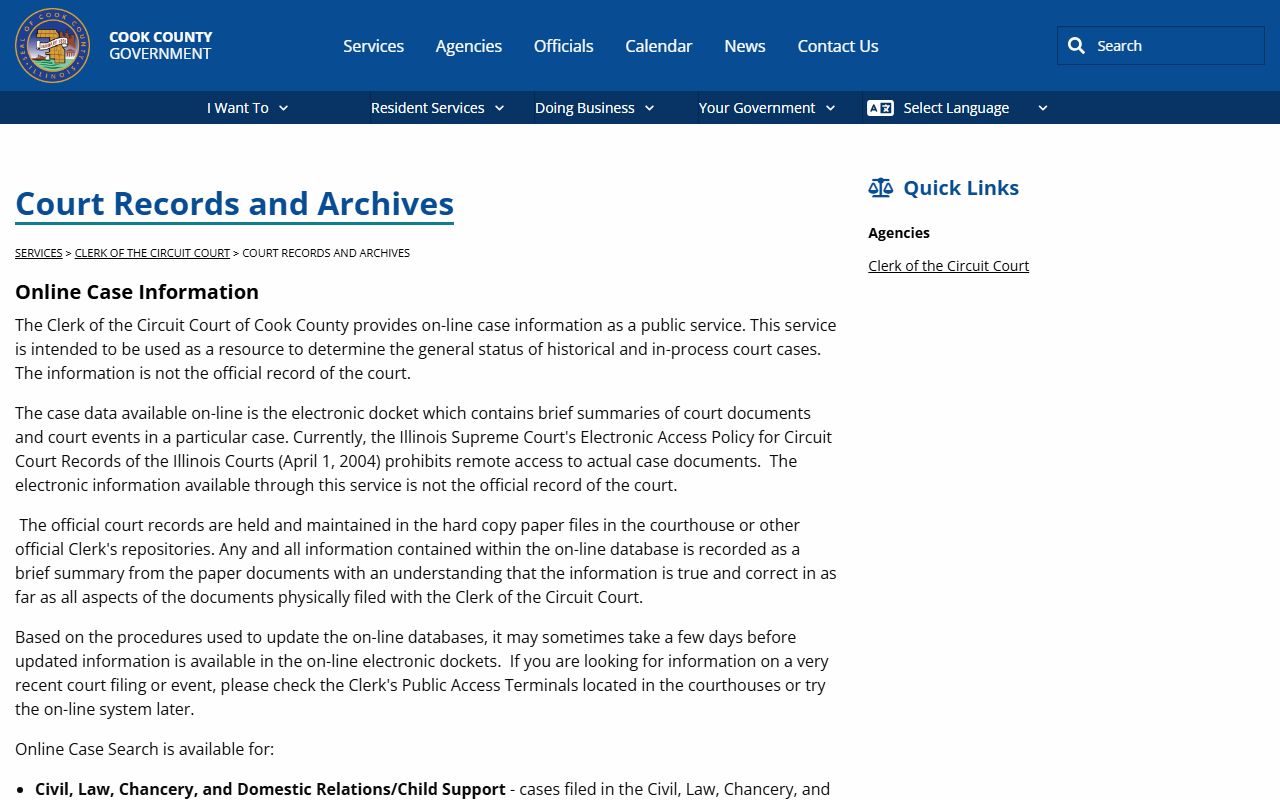
The Cook County online case information page lets you search certain case types from home. You can look up civil, law, chancery, and domestic relations cases online. Traffic ticket cases are also searchable, including DUI, speeding, and suspended license cases. County division matters like name changes and real estate tax cases appear in the system too. The Court Call feature shows cases set for the current day and the next five business days in Cook County.
Full criminal case files are not available online in Cook County. This is a key difference from most other Illinois counties. If you need to look up criminal history court records, you must go in person. The clerk's website states it clearly: criminal records are only available in person. If a person was arrested but never charged or never went to court, the court will not have a record of that arrest in Cook County.
Cook County Criminal History Department
The Cook County Criminal Department handles all criminal case records. The main office is at the Richard J. Daley Center, 50 West Washington Street, Room 1006, Chicago, IL. The phone number for the criminal department is (312) 603-4641. You need a valid photo ID to view case files in person.
Cook County also has branch courts that handle criminal cases. Branch Court 23 and 29 are at 5555 W. Grand Ave, Chicago, IL 60639. Branch Court 35 and 38 are at 727 E. 111th Street, Chicago, IL 60628. Branch Court 43 and 44 are at 3150 W. Flournoy St, Chicago, IL 60612. All branch courts are open Monday through Friday, 8:00 a.m. to 4:00 p.m. The branch you need depends on where the arrest took place in Cook County.
On-site files at the Daley Center cover cases filed in the past four years, unless a case is still pending in court. Older criminal history records may need to be pulled from storage, which can take more time. Call ahead if you need files from older cases in Cook County.
Getting Criminal History Dispositions in Cook County
A certified disposition shows what happened with a criminal case. It is one of the most requested criminal history documents in Cook County. To get one, you need the defendant's name, date of birth, and date of arrest. The clerk provides dispositions for Chicago cases only at the main office. For suburban district cases in Cook County, you must contact the specific suburban district where the case was heard.
The Cook County court records and archives page has more details on how to access criminal history records. Under the Uniform Conviction Information Act (20 ILCS 2635), conviction data in Illinois is public. This applies to Cook County criminal history records as well. Anyone can ask for conviction information without giving a reason.
Illinois State Criminal History Resources for Cook County
Beyond the county court system, Cook County residents can also search criminal history records through the Illinois State Police Bureau of Identification. The BOI keeps statewide criminal history data for all of Illinois, including Cook County. A name-based UCIA check costs $16.00 by paper or $10.00 through Live Scan. Fingerprint-based checks are $20.00 by paper or $15.00 through Live Scan for state-only results.
Cook County has many Live Scan vendors where you can get fingerprinted for a criminal history check. Use the ISP Live Scan vendor lookup to find one near you. The Access and Review process lets you view your own criminal history at no cost from the ISP. Visit any law enforcement facility or licensed vendor in Cook County to start the process. Under the Criminal Identification Act (20 ILCS 2630), the ISP must provide your criminal history transcript when you submit fingerprints through Access and Review.
The Office of the State Appellate Defender has info on expunging or sealing criminal history records. Cook County residents file expungement petitions at the Circuit Clerk office.
Note: For arrests in Chicago specifically, you may also need a Chicago RAP sheet from the Chicago Police Department, which is separate from the county court records.
Cities in Cook County
Cook County has dozens of cities and towns. All criminal cases go through the Cook County Circuit Court system. Many of the largest cities in Illinois are in Cook County.
Other Cook County communities include Tinley Park (partially), Hoffman Estates (partially), and Elgin (partially). Some cities sit in more than one county.
Nearby Counties
These counties border Cook County. If you need criminal history records from a case outside Cook County, check the county where the case was filed.